|
The Science Of Words: How Language Designs Your Life
I’ve been thinking this week about the language we use when we talk about ourselves. Not the casual “fine thanks,” we give someone who asks how we are, when what we really mean is, “I’m having a low-level existential meltdown.” It’s the language underneath that I’m interested in.
I’m talking about the narrative we run when we’re not paying attention. The labels we subconsciously give ourselves. The stories we repeat so often they start to sound like indesputable facts: “I’m always behind.” “I’m terrible with money.” “I never finish anything.” “I’m too set in my ways.” “I can’t change.” “This is just how I am.”
These thoughts may feel true when they occur. But when we continue to repeat them, they stop being mildy self-effacing comments and start becoming rules we live by. Our language doesn’t just describe our life. It designs it. The words we use repeatedly become the lens we look through, shaping what we notice, what we ignore, what we believe is possible, and what we do next. My free guide, 5 Hidden Thought Patterns That Keep Women Stuck During Major Life Transitions, explores some of the deeper beliefs often sitting underneath that inner dialogue.
This week, I caught myself doing it. I heard myself saying, “I’m terrible for shiny object syndrome. I keep chasing new distractions all the time.” To be fair, I can see where that comes from. My puppy brain does tend to chase ideas like it’s never seen a stick before. A new offer, a new piece of content, a new strategy, a new book idea, a new possibility. Before I know it, I’m mentally rearranging my entire business while the original task sits quietly in the corner, like a wallflower waiting to be asked to dance.
Okay, there is a pattern to notice. My self-talk was not a neutral sentence. It turned creativity into a flaw. It made me sound like a woman who cannot be trusted near a spreadsheet, a Canva template, or a mildly interesting conversation. “I’m terrible for shiny object syndrome” creates shame. “I have a creative mind that needs structure” creates responsibility and possibility. That is a very different energy.
The language we use in our self-talk matters alot, not just because we need to be kinder to ourselves. Our brain is always listening. It is a pattern-seeking machine, constantly gathering proof for the things we repeatedly tell it. What we say repeatedly becomes what we expect. What we expect shapes what we attempt. And what we attempt shapes the life we end up living. This is the kind of work we do inside The Breakthrough Sessions: noticing the patterns that are quietly running the show, challenging the beliefs that have started to feel like facts, and creating a clearer, more self-led way forward. You can read more about them here.
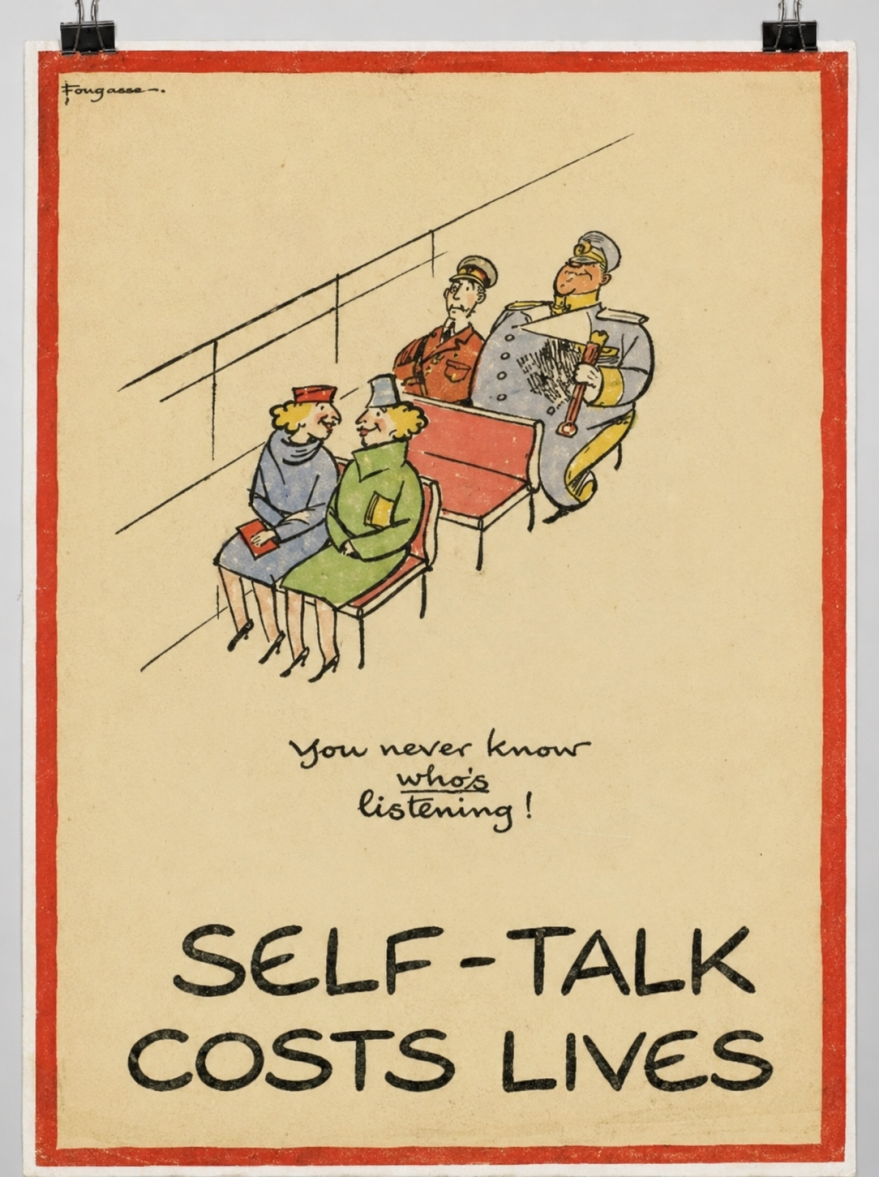
Forget “careless talk costs lives.” Self-talk costs lives too — not literally, perhaps, but it can cost you the life you could be living.
Making It Intentional
The most useful shift is often not from negative language to positive language. It is from fixed language to curious language.
Instead of “I’m stuck,” try, “Where am I waiting for permission?” Instead of “I have no choice,” try, “What choices am I not allowing myself to see?” Instead of “I always mess this up,” try, “What pattern is asking to be interrupted?” Instead of “I don’t have time,” try, “What am I currently prioritising instead?” Instead of “This is just how I am,” try, “Is this who I am, or who I learned to be?”
So this week, pay attention. Not obsessively. Not perfectly. Just gently. Notice one phrase you keep repeating about yourself or your life. Then ask: is this opening possibility, or closing it down?
Get In Touch
If enough is enough and you’re ready to move forward, but you don’t know where to start, book a Discovery Call. We’ll explore what’s keeping you stuck, what needs to shift, and whether coaching with me is the right next step.
|